
- High Littleton
- Paulton
- Midsomer Norton – High Street
- Midsomer Norton
- Midsomer Norton Station
- Haydon
- Radstock
- Chilcompton
- Westfield
- Camerton
- Clandown
- Coleford – Coal Barton
- Coleford – Mackintosh
- Holcombe
- Old Mills
- Writhlington
- Timsbury
- Somerset Coal Mining – History!
- Paulton Basin
- Farrington Gurney
- Tunley
- Westfield Old Pit Road
- Newton St Loe
- Clandown
- Brandy Bottom
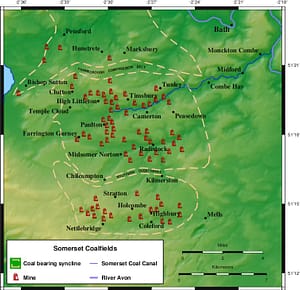 We believe that Somerset coal was first discovered by the Romans. They were in the West Country 43AD, and there are references to it being used at the Temple of Minerva in Aqua Sulis (Bath). The coal used was probably found in coal outcrops around Stratton-on-the-Fosse, and transported along the Roman road – the Fosseway – for use in Bath.
Early coal workings, from coal outcrops, were largely in the Nettlebridge Valley, around Stratton-on-the-Fosse and Coleford, and to the North of the Coalfield, around High Littleton. It is estimated that output in 1500 was estimated about 10,000 tons a year, and that this had increased 10-fold by the late 1600s.
With coal being worked to the north and the south, it was only a matter of time before someone explored the possibility of coal “in middle”. In 1793, coal was found when Old Pit (situated between Middle Pit Radstock and Clandown Pit) was sunk on Earl Waldegrave’s Manor of Radstock.
As the eighteenth century drew to a close, Somerset mining continued to expand, reaching its peak of production in the first decades of the twentieth century. As more deep mines were sunk, and steam power was used to help raise coal, a problem emerged: how to get the coal to the waiting markets.
Somerset roads were notoriously unsuited to the transport of heavy goods like coal by pack horse or horse and cart. The solutions came in the form of first canals and then railways. Work on the Somerset Coal Canal began in 1795, with branches to Paulton and to Radstock, although the latter was not really operational until 1815. A separate canal, to serve the southern part of the coalfield, was never fully completed.
The first railway to serve the coalfield was the Wilts Somerset & Weymouth Railway, which opened from Frome to Radstock in 1854. Then, nearly 20 years later, the Bristol and North Somerset Railway opened in 1873 and the Somerset & Dorsey Railway extension to Bath in 1874.The final line, the Great Western Railway from Hallatrow to Camerton, opened in 1882 and its extension to Limpley Stoke in 1910.
Access to markets supported the expansion of production, with annual output reaching its highest level of 1,250,000 tons in the 1910s. However, the coalfield’s older pits were now reaching the end of their economic viability, and a series of closure soon followed: Greyfield, once the largest pit closed in 1911, and Huish following in 1912. Edford Colliery closed in 1915, and the last of the Timsbury group closed in the following year.
The post war years and the depression brought strikes in 1921 and 1926, and saw investment dwindle: Farrington and Clutton, and the collieries in Coleford, had all closed before the end of the decade. Further closures followed before the outbreak of the second world war, with the demise of Dunkerton, Clandown, Preston, Middle Pit Radstock and Moorwood.
During this turbulent time, ownership of the collieries was concentrated in the hands of one or two key players. Many of those in the central coalfield area came under the ownership of Sir Frank Beauchamp’s Somerset Collieries Ltd. By the mid-1930 there were some 14 pits at work, including two drift mines. All except Mells Colliery would survive until nationalisation in 1947.
On 1 January 1947 private mining in Somerset came to an end, as the remaining 12 mines were nationalised:
- New Rock
- Charmborough
- Norton Hill
- Braysdown
- Writhlington
- Kilmersdon
- Ludlows
- Springfield (later became the coal winding shaft that was better known as Old Mills)
- Marsh Lane (the last pit in Somerset to use the Guss & Crook)
- Camerton
- Pensford
- Bromley (the last pit in Somerset to use horses for hauling tubs underground)
Further changes were to come, and over the next 20 years most of these pits closed:
- Charmborough 1947
- Marsh Lane 1949
- Camerton 1950
- Ludlows Radstock 1954
- Bromley 1957
- Pensford 1958
- Braysdown 1959
- Norton Hill 1966
- Old Mills 1966
- New Rock 1968
This left just Kilmersdon & Writhlington working. The final coal was brought to the surface 1973, ending two millennium of coal mining in Somerset.